

The Process Mining research area at our department studies how organizations can discover, understand, and improve the way their work actually gets done. Business processes such as order handling, invoicing, or customer service leave traces in information systems like ERP, CRM, or ticketing platforms. Process mining uses these event logs to reconstruct how processes really run, which often differs from how they were designed on paper.
Our work combines process mining with data science, machine learning, and visual analytics. We are particularly interested in the steps that tend to cause problems in practice: preparing and repairing imperfect event data, making complex processes understandable through visualization, and using simulation to explore the effects of process changes before they are made.

Opportunities for Organizations
Process mining gives organizations a data-based view of their operations, using information they usually already collect. Typical applications include:
- Transparency: Seeing how cases actually flow through a process, including variants, rework loops, and exceptions that are often missing from official documentation.
- Finding bottlenecks: Identifying where cases wait, where work is repeated, and which handovers slow things down.
- Conformance checking: Comparing actual behavior with the intended process or with internal and regulatory rules, and locating deviations.
- Better-informed decisions: Using measurable facts when choosing which processes to improve or automate.
- Monitoring change: Checking over time whether a process change had the intended effect.
The value depends heavily on data quality and on asking the right questions. Process mining shows where to look; understanding why a process behaves the way it does still requires the knowledge of the people who run it.
Key Research Themes
Process simulation: OCPN Studio
Understanding a process is only the first step. Simulation helps explore “what if” questions before anything is changed in practice: How would throughput times develop if order volume increased? Where would additional staff have the largest effect? How would a new approval step affect waiting times? Simulation results are only as reliable as the model behind them, so we calibrate models against historical event data wherever possible.
We model processes as object-centric Petri nets (OCPNs), a formal notation that describes how several business objects interact within one process. OCPN Studio, a tool developed in our group, can be used to build, edit, and simulate such models and to compare alternative process designs.
Visual Analytics for Processes
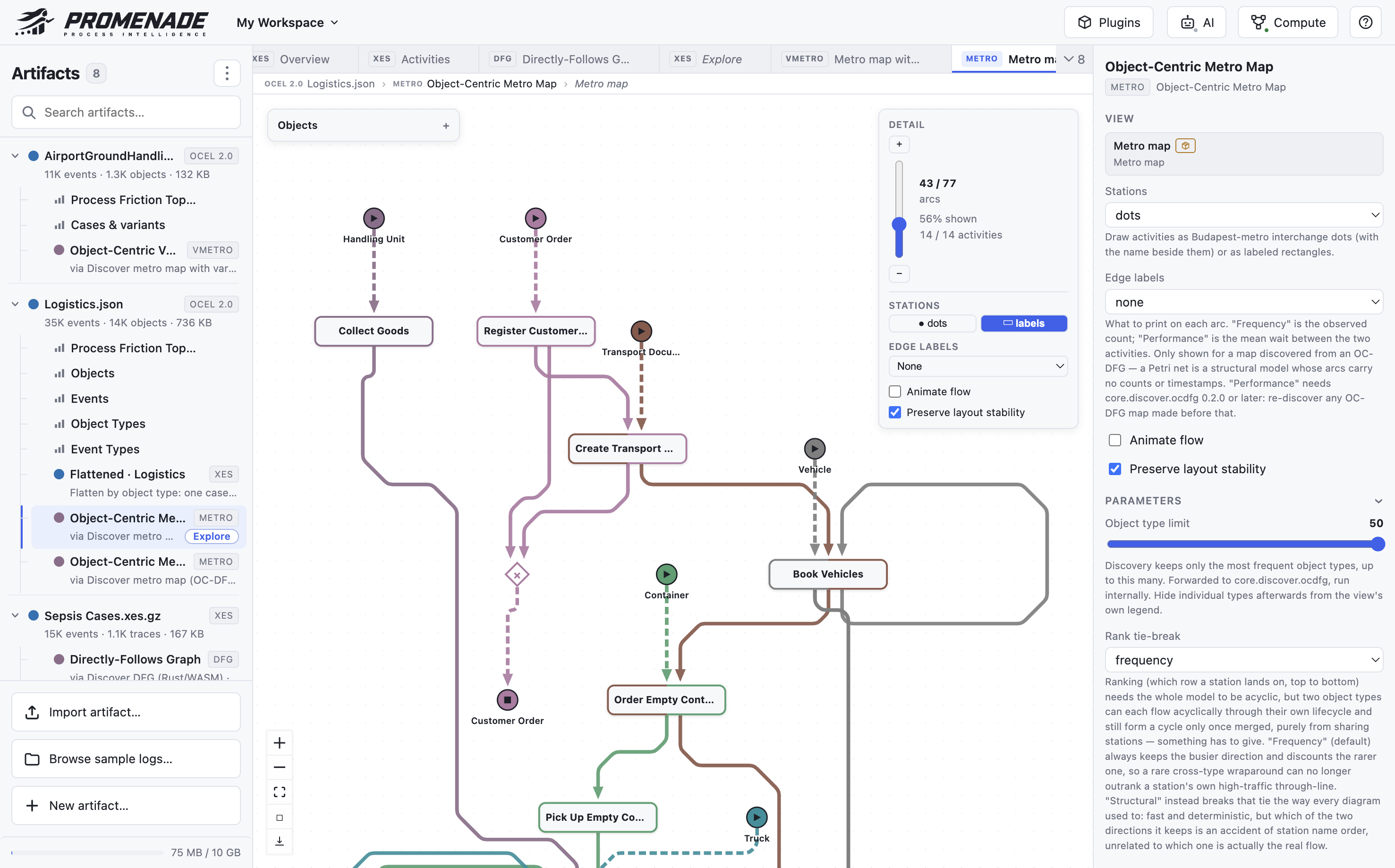
Process models discovered from real data quickly become hard to read, especially when several interacting business objects such as orders, items, and deliveries are involved. A central part of our work is therefore visualizing processes in a way that both analysts and business stakeholders can understand and explore.
Our own Promenade App makes complex, object-centric processes accessible through interactive visualizations. It lets users navigate from a high-level overview down to individual cases and follow how different objects move through a process together.
Object-centric process mining
Classical process mining assumes that every event belongs to exactly one case. In practice, one event often concerns several objects, for example a delivery that contains items from multiple orders. Forcing such data into a single-case view can distort the results. We work on object-centric techniques that keep these relationships intact, which is especially relevant for data from ERP systems.
Event log quality and GNN-based log repair
Process mining results are only as good as the underlying data. Real-world event logs are often incomplete or inconsistent: timestamps are missing, the same activity is recorded under different names, or events are linked to the wrong case. We are developing methods based on graph neural networks (GNNs) that learn typical patterns of a process from the data and use them to flag likely errors and suggest corrections. This is ongoing research. Automated repairs are meant to support analysts rather than replace their review, and they work best when enough reasonably clean data is available to learn from.
Open Research Challenges
Process mining is used more and more in industry, but many questions remain open. The ones we focus on include:
- Data quality: Detecting and repairing errors in large event logs without requiring manual expert work for every data set.
- Complexity: Presenting processes with many activities and interacting objects in a way that stays understandable for the people who have to act on the results.
- From analysis to action: Moving from describing what happened toward predictions and simulations that are reliable enough to support real decisions.
- Data extraction: Getting meaningful object-centric event data out of complex source systems such as ERP platforms, which often takes more effort than the analysis itself.
- Explainability: Making machine-learning-based results, such as automated log repairs, transparent enough that users can check what was changed and why.
Getting Started with Process Mining
A first process mining project does not have to be large. In our experience, it helps to:
- Start with one process and one question: For example, why invoices in purchase-to-pay are paid late, or where incident tickets get stuck.
- Check the available data early: Most ERP, CRM, and ticketing systems record the necessary events, but extracting and cleaning them is usually the most time-consuming part of a first project.
- Involve the process owners: Results become useful when data experts and the people who run the process interpret them together.
- Plan in iterations: A first analysis usually raises new questions. Over time, process mining can move from a one-off project to regular monitoring.
If you would like to find out whether process mining makes sense for your organization, we are happy to talk. We offer a short information session in which we present our research, show our tools, and discuss your processes and data. This works equally well if you are only starting to explore the topic or if you already use process mining and have run into specific problems. We also welcome motivated students and thesis candidates interested in process mining topics.
Contact us!
Please send an email to István Koren for further inquiries.